


Page 7 - Aesthetic art-7
P. 7
1 1       Fundamentals of Arts
                          undamen
                                                  t
                                                               f Art
                                                    als o
                       F
                                                                          s


         Elements of Art
         Elemen            t s o    f Art
         Elements of art are the basic fundamentals that are necessary to understand in order to
         make a technically correct and aesthetically beautiful piece of art..


         Line

         The path followed by a moving point or the connector between two
         points is known as line. It is the foundation of all drawing. Lines are also                     straight
         called as “strokes”. A line has a width, direction, and length. The width of                     dotted
         line is called its thickness. Lines are of two types:                                            dashed
         i.    Virtuous Line or Mechanical Line: Such lines are drawn with the help                       wavy
             of mechanical tool or instrument.                                                            free (curve)

         Ii.   Spontaneous Line: Lines drawn freely with hands without using any
             tool like scale etc.

         Form

         Form of an object is created by combining two or more different shapes.
         It is considered to be three dimensional. Due to its visual and formal
         weight different forms have different effects on our sensitive mind and
         each form symbolises a different meaning. Forms are of two types:
         i.     Symmetrical form: Where half portion of the form is just the mirror
             image of the other half.
         ii.   Asymmetrical  form:  Where  both  halves  of  the  form  are  different
             from each other.

         Shape
         The area covered by an object when placed in two dimensional art is
         known as shape. Shapes are of two types:

         i.     Geometric (square, circle, triangle etc)
         ii.   Organic (shape of a puddle, blob, leaf etc)

         Colour
         Use of HUE in an artwork is known as colour. Colour is divided into three
         categories:

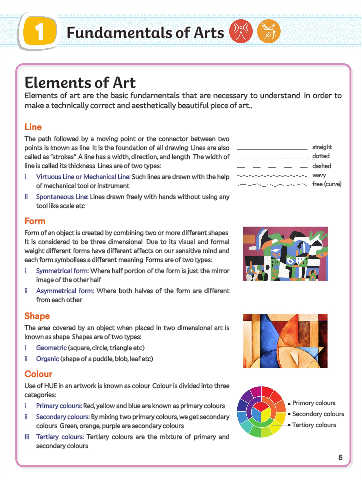
         i.    Primary colours: Red, yellow and blue are known as primary colours.                  Primary colours
         ii.    Secondary colours: By mixing two primary colours, we get secondary                  Secondary colours
             colours. Green, orange, purple are secondary colours.                                  Tertiary colours
         Iii.    Tertiary  colours:  Tertiary colours are the mixture of primary and
             secondary colours.
                                                                                                                   5

