


Page 10 - Aesthetic art-7
P. 10
Principles of Art
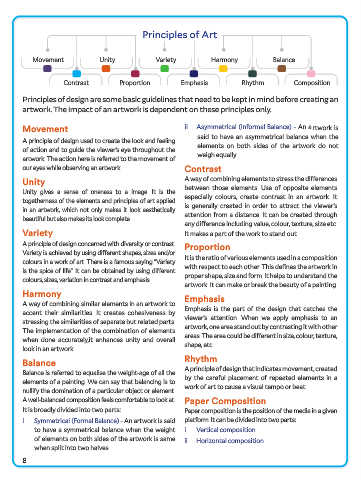
                                                 Principles of Art


            Movement              Unity              Variety            Harmony              Balance


                      Contrast           Proportion           Emphasis            Rhythm            Composition


        Principles of design are some basic guidelines that need to be kept in mind before creating an
        artwork. The impact of an artwork is dependent on these principles only.


         Movement                                              ii.   Asymmetrical (Informal Balance) - An artwork is
         A principle of design used to create the look and feeling   said to have an asymmetrical balance when the
                                                                   elements on both sides of the artwork do not
         of action and to guide the viewer’s eye throughout the    weigh equally.
         artwork. The action here is referred to the movement of
         our eyes while observing an artwork.                  Contrast
         Unity                                                 A way of combining elements to stress the differences

         Unity gives a sense of oneness to a image. It is the   between those elements. Use of opposite elements
         togetherness of the elements and principles of art applied   especially colours, create contrast in an artwork. It
         in an artwork, which not only makes it look aesthetically   is generally created in order to attract the viewer’s
         beautiful but also makes its look complete.           attention from a distance. It can be created through
                                                               any difference including value, colour, texture, size etc.
         Variety                                               It makes a part of the work to stand out.
         A principle of design concerned with diversity or contrast.     Proportion
         Variety is achieved by using different shapes, sizes and/or   It is the ratio of various elements used in a composition
         colours in a work of art. There is a famous saying “Variety   with respect to each other. This defines the artwork in
         is the spice of life”. It can be obtained by using different   proper shape, size and form. It helps to understand the
         colours, sizes, variation in contrast and emphasis.
                                                               artwork. It can make or break the beauty of a painting.
         Harmony                                               Emphasis

         A way of combining similar elements in an artwork to
         accent their similarities. It creates cohesiveness by   Emphasis is the part of the design that catches the
         stressing the similarities of separate but related parts.   viewer’s attention. When we apply emphasis to an
         The implementation of the combination of elements     artwork, one area stand out by contrasting it with other
         when done  accurately,it enhances  unity and overall   areas. The area could be different in size, colour, texture,
         look in an artwork.                                   shape, etc.
                                                                 Rhythm
         Balance
         Balance is referred to equalise the weight-age of all the   A principle of design that indicates movement, created
                                                               by the careful placement of repeated elements in a
         elements of a painting. We can say that balancing is to   work of art to cause a visual tempo or beat.
         nullify the domination of a particular object or element.
         A well-balanced composition feels comfortable to look at.   Paper Composition
         It is broadly divided into two parts:                 Paper composition is the position of the media in a given
         i.     Symmetrical (Formal Balance) - An artwork is said   platform. It can be divided into two parts:
             to have a symmetrical balance when the weight     i.     Vertical composition.
             of elements on both sides of the artwork is same   ii.     Horizontal composition.
             when split into two halves.
        8

